
Backyard Winter Bird Survey Instructions
Count Your Birds: February 14-15, 2026
Thank you for participating! Your data helps us understand winter bird trends across New Hampshire. This Survey began in 1967 as the “Cardinal-Tufted Titmouse Survey,” and, in 1987, expanded to include data on all winter birds. We hope you have fun during the Survey weekend learning about the birds in your yard and feel proud to be a part of this important science effort.
When should I watch?
Please remember only report birds on February 14th and/or 15th , and check off the dates you observed them when submitting your data. This timing helps us capture a snapshot of winter bird activity across New Hampshire, even if it means missing out on some of the exciting birds you might have seen earlier in the week. Count for as little or as much time as you’d like, just be sure to record how long you watched.
How many birds, squirrels, and chipmunks should I record?
Record only the highest number of each species you see at one time during the survey weekend. For example, if you spot 3 Blue Jays at 10 am and 1 more at 11 am, report a total of 3 Blue Jays. If you don’t see any birds, please still submit your result. This data is equally valuable to us!
What counts as a backyard?
Count any birds you can see from your backyard, whether they’re at your feeder, flying overhead, or even swimming in a river bordering your yard. If you can spot it from your house or yard, it counts. Note: If you watch from multiple residences, submit data from each location separately.
The bird I saw isn’t on the survey form. Does it still count?
Yes! Use the blank spaces to report the species and number seen. Write-ins are often unusual species so be sure to add a detailed description of the bird you saw in the comments. Photos also help our biologists confirm a rare sighting.
Count only the birds you can identify.
Record only the birds you can confidently identify. If you are unsure take a photo and send it in or leave the bird off of your count. If you can identify a bird to group (e.g. hawk or sparrow) report it as such (e.g. unidentified hawk).
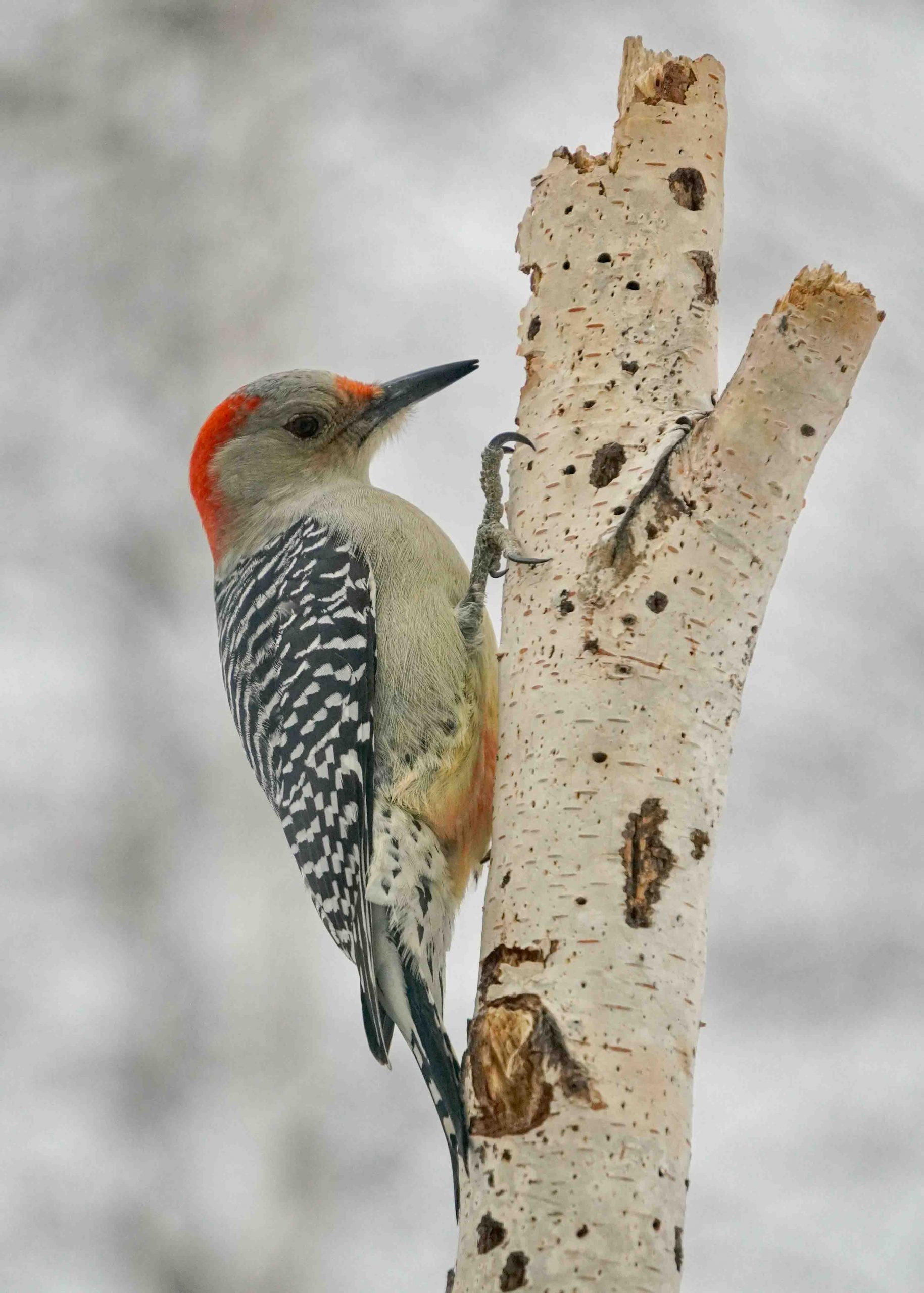
Red-bellied Woodpecker by Grace McCulloch.
Share your photos.
Photos are a great way to confirm a species. With your permission, we would love to include them in our outreach materials.
Tag @nhaudubon on Instagram or New Hampshire Audubon on Facebook. Use #BackyardWinterBirdSurvey to see your photos and other participants.
Pay close attention to commonly confused species!
A few species can be a little tricky to differentiate—even for the best of birders. If you have a Purple Finch (for example) please add notes in the comments section of the form on what helped you distinguish it from the more common House Finch. Sharp-shinned Hawks and Cooper’s Hawks can also be difficult to distinguish. Check out our guide to Commonly Confused Species below and if in doubt snap a photo!
Pay close attention to commonly confused species!
A few species can be a little tricky to differentiate—even for the best of birders. If you have a Purple Finch (for example) please add notes in the comments section of the form on what helped you distinguish it from the more common House Finch. Sharp-shinned Hawks and Cooper’s Hawks can also be difficult to distinguish. Check out our guide to Commonly Confused Species below and if in doubt snap a photo!
Submit your data!
Once you’ve read the instructions you are ready to submit your data.