
Winter Trend: Increasing
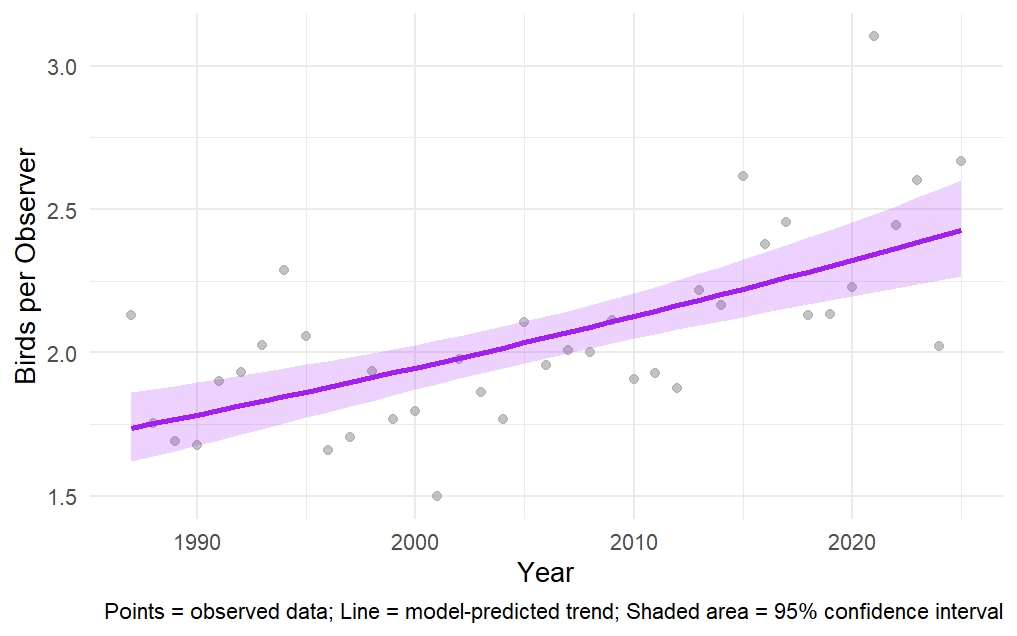
Tufted Titmice, 1987–2025.
The dark purple line shows the trend over time predicted by our statistical model, while the shaded purple area shows where we are 95% confident the true trend lies. Gray points are the number of titmice actually observed in participants’ backyards, averaged per observer.

What’s the Story?
Who doesn’t love a Tufted Titmouse? Believe it or not, there was a time when this species wasn’t found in New Hampshire at all. Tufted Titmice were originally a southern species, but their range has expanded northward, helped along by bird feeders that provided reliable food during cold winters.
The Tufted Titmouse is also one of the two species that launched this project! In 1967, NH Audubon began the “Cardinal–Tufted Titmouse Survey” to track the range expansion of both Northern Cardinals and Tufted Titmice into New Hampshire. The survey later evolved into the Backyard Winter Bird Survey we know today.
Our statistical analysis shows that increase has continued (albeit at a slower rate) in recent decades: a negative binomial regression shows a significant upward trend (β = 0.009 ± 0.002 SE, z = 5.513, p < 0.001).
This translates to reports of Tufted Titmice increasing by about 1% per year, even when accounting for changes in the number of Backyard Winter Bird Survey participants over time.
Tufted Titmice are adaptable birds, thriving in areas with tall deciduous trees but even a few trees in a city or suburb can provide good habitat. Their northward expansion has been limited by cold winters and they remain uncommon in northern Coos County.

Feeding Tips
- Black oil sunflower seeds are a Tufted Titmouse favorite, though striped sunflower seeds and safflower are also good options.
- Tufted Titmice will readily visit hanging tube feeders.

In Your Backyard
- Look for Tufted Titmice in areas with mature deciduous trees.
- They are often seen traveling in mixed flocks with Black-capped Chickadees, woodpeckers, and nuthatches.

ID Tips
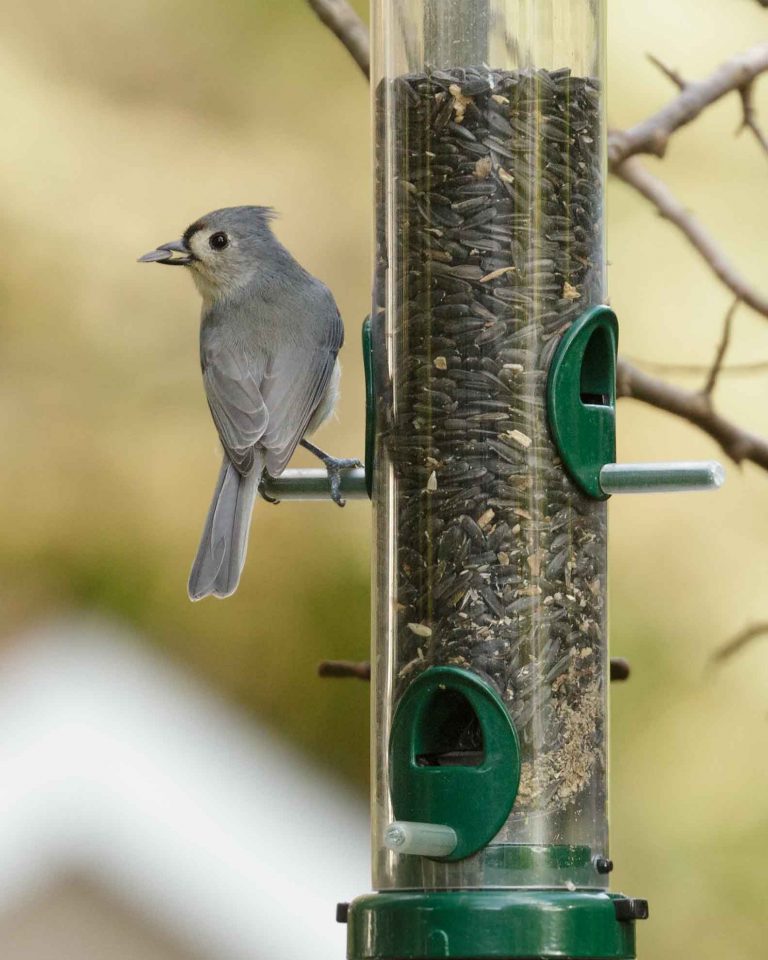
Tufted Titmouse by Len Medlock.
Tufted Titmice are gray overall with some ruddy/orange on their sides. Look for the crest and black on the forehead.