
Winter Trend: Increasing
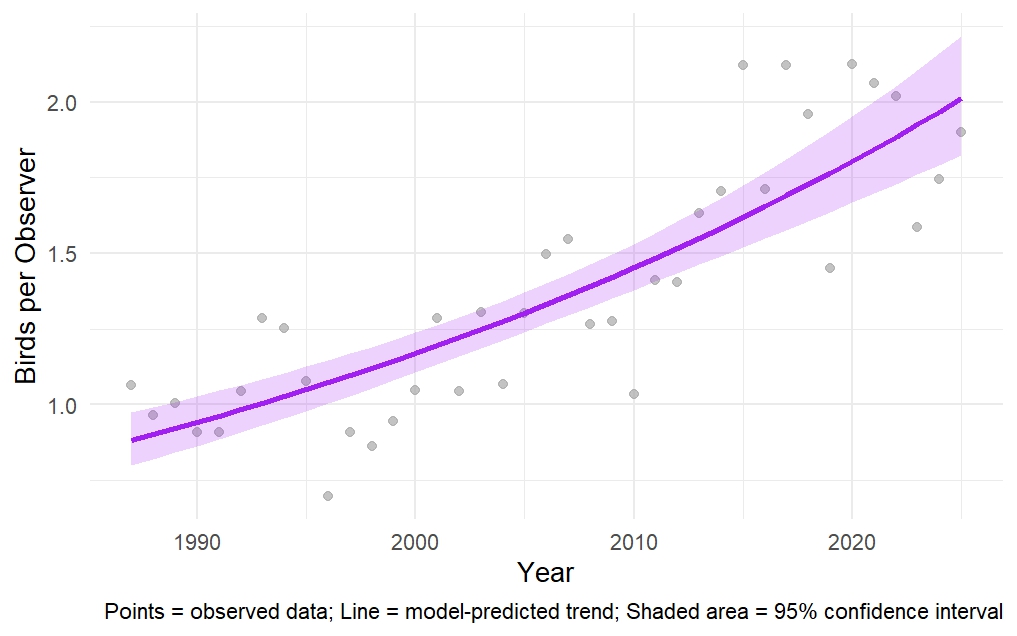
Northern Cardinals, 1987–2025.
The dark purple line shows the trend over time predicted by our statistical model, while the shaded purple area shows where we are 95% confident the true trend lies. Gray points are the number of cardinals actually observed in participants’ backyards, averaged per observer.

What’s the Story?
There was a time when Northern Cardinals were not a regular part of the New England landscape. Before the early 1900s they were rare in New Hampshire any time of year. Their range began expanding northward, with more sightings in the 1930s and 1940s. In fact, the Backyard Winter Bird Survey started in 1967 as the “Cardinal–Tufted Titmouse Survey”, created by NH Audubon to track this expansion. Although the survey later shifted to include all winter birds, the dramatic increase in Northern Cardinals was what first inspired the project.
Our statistical analysis shows that increase has continued (albeit at a slower rate) in recent decades: a negative binomial regression shows a significant upward trend (β = 0.022 ± 0.002 SE, z = 9.612, p < 0.001).
This translates to reports of Northern Cardinals increasing by about 2% per year, even when accounting for changes in the number of survey participants over time.
Northern Cardinals are well adapted to rural and suburban backyards. As shrubland birds, they benefited when much of New Hampshire was deforested in the 1800s, thriving in young forest and shrubby areas. Unlike some species, they managed to persist as the forest regrew, remaining common in residential areas, towns, and parks.
Bird feeding helps support cardinals in winter and landscaping with dense shrubs provides both food and cover. A warming climate may have also contributed to their steady increase, as warmer winters allow this species to persist at the northern end of its range.

Feeding Tips
- Black oil sunflower seeds are a Northern Cardinal favorite, but striped sunflower seeds and safflower are also good choices.
- Northern Cardinals will visit hanging tube feeders, but they often prefer platform feeders or foraging on the ground.

In Your Backyard
- Northern Cardinals readily adapt to human landscapes and are common in backyards, especially near forest edges with plenty of shrubs for cover.
- Protection from predators is important. When Northern Cardinals aren’t at your feeder, you’ll often find them perched in dense shrubs or along tree lines.

ID Tips
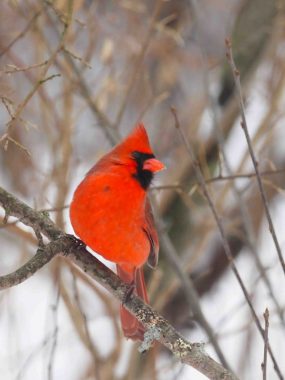
Male Northern Cardinal by Caitlin McMonagle.
Male Northern Cardinals are bright red. Both males and females have big, red bills, with black on the face next to the bill.
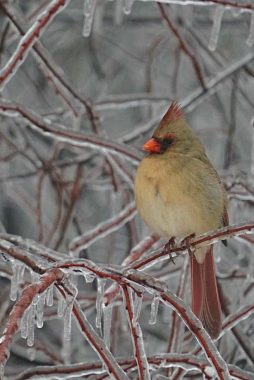
Female Northern Cardinal by Fiona McCulloch.
Female Northern Cardinals are brown overall with a tinge of red. Like the males, they have a prominent crest.